01
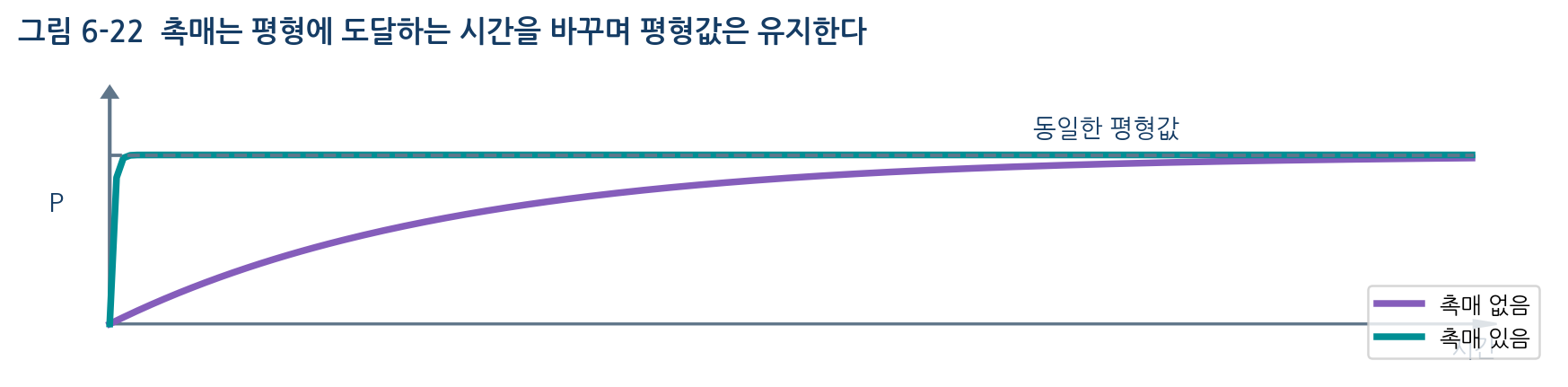
Enzymes affect rate, not the equilibrium position
- Equilibrium is the state where forward and reverse rates are equal, with K = [P]eq/[S]eq for a 1:1 reaction
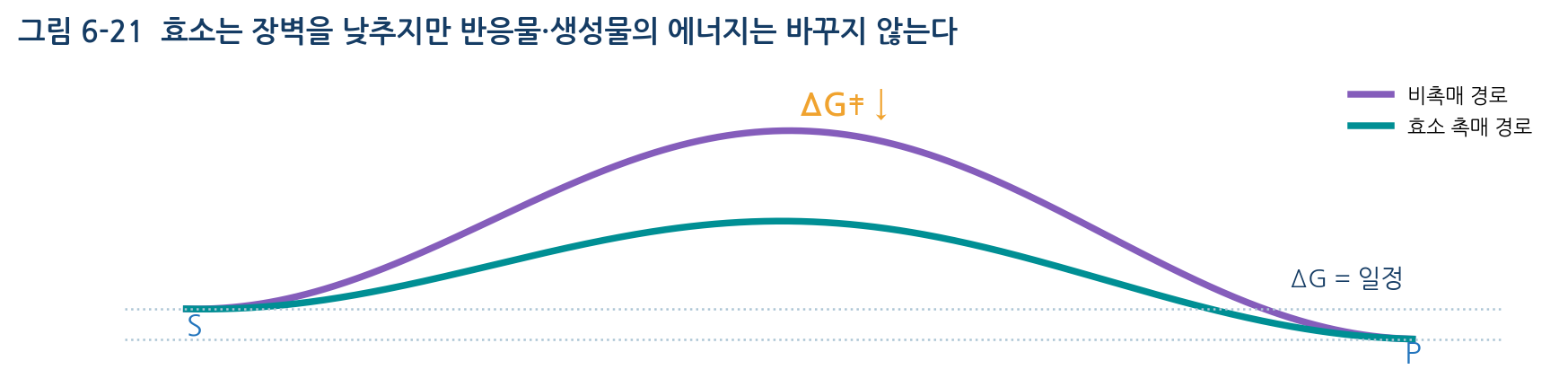
- Equilibrium is set by standard chemical potentials and temperature, and adding an enzyme does not change the free energies of reactants and products
- An enzyme accelerates both directions, so it cannot change the equilibrium constant at the same conditions
- The statement that an enzyme promotes only the forward reaction is wrong about equilibrium
- Cells are open systems with continuous product removal and substrate supply, so metabolic flux depends strongly on enzyme amount and activity
- ΔG = ΔG°′ + RT ln Q′ and at equilibrium ΔG°′ = -RT ln K′eq, for example K′eq = 4.0 gives ΔG°′ about -3.43 kJ/mol at 298 K
02
Rate and equilibrium are different quantitative concepts
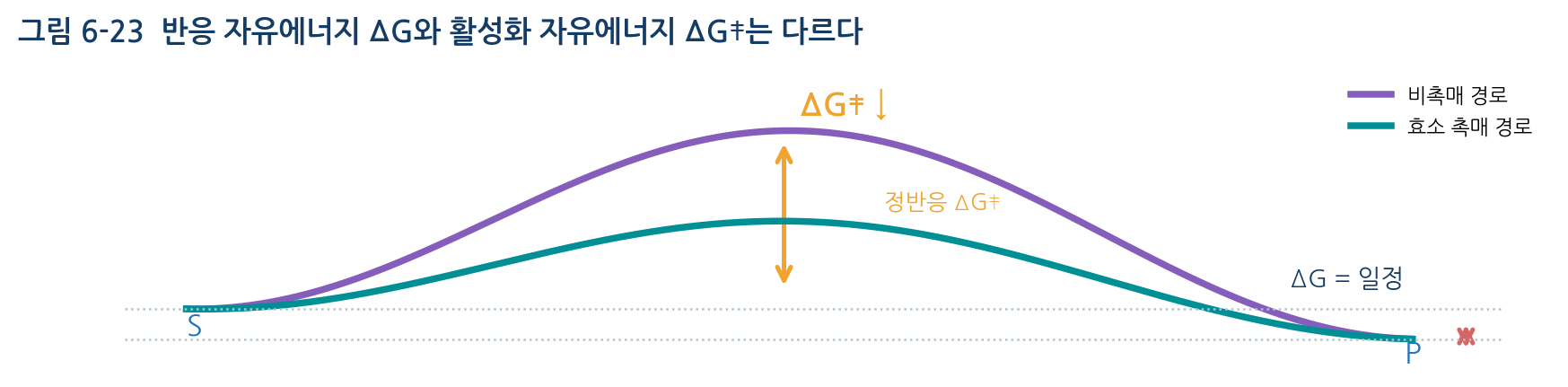
- ΔG is the difference between product and reactant states, the thermodynamic tendency to proceed
- ΔG-double-dagger is the barrier that must be crossed from the starting state to the transition state
- A negative ΔG with a large ΔG-double-dagger can still give a very slow reaction
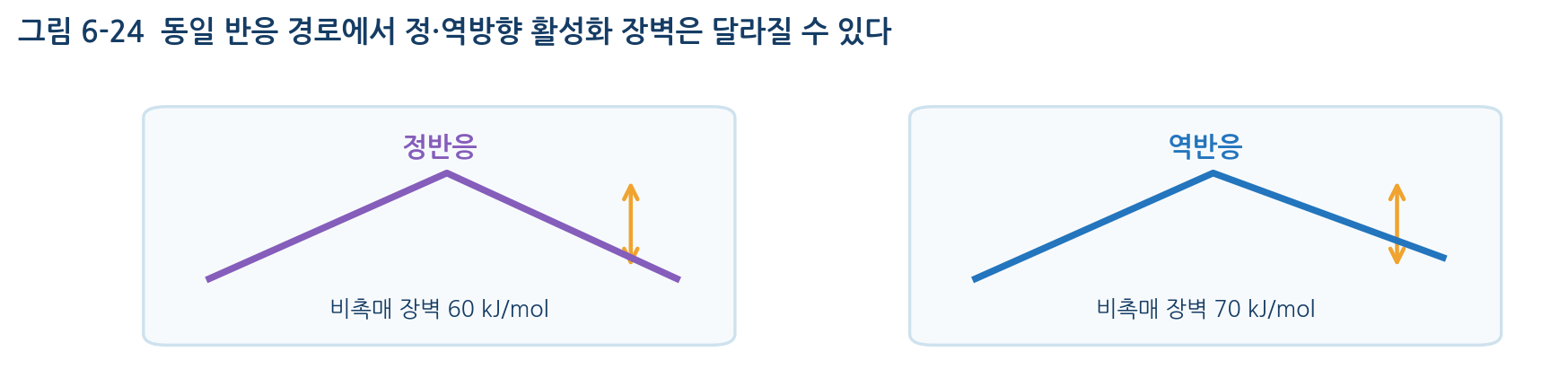
- For an idealised single transition state, forward ΔG-double-dagger minus reverse ΔG-double-dagger equals the reaction ΔG
- Example: reactants 0, products -10 and uncatalysed transition state +60 kJ/mol give 60 and 70, lowered by 30 to 30 and 40, while the difference stays -10
- k is about (kB T/h) exp(-ΔG-double-dagger/RT), and at 298 K a ΔΔG-double-dagger of 17.1 kJ/mol gives roughly 1.0e3-fold if pre-exponential factors match
- The Arrhenius Ea and the transition-state ΔG-double-dagger are related but not the same physical quantity
03
Catalytic power and specificity combine several principles
- The active site promotes substrate approach, fixes orientation and preferentially stabilises transition-state charge and geometry
- Transient covalent intermediates mean no single principle such as weakening one bond explains all catalysis
- A transition state is a short-lived high-energy arrangement on the reaction coordinate, not a separable substance
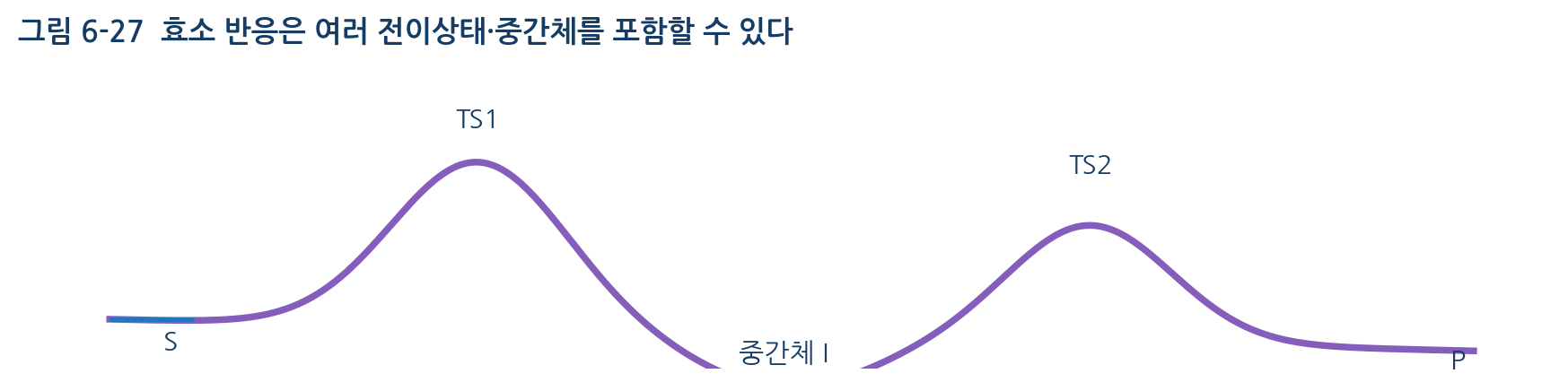
- Multi-step reactions have a transition state and intermediate per step, and the tallest peak alone does not fix the overall rate
- Specificity is selective binding and product distribution, to be read as a large rate difference rather than absolute non-reaction
- Induced fit and conformational selection are not exclusive, and real enzymes can show both
04
Weak enzyme-substrate interactions matter most at the transition state
- Hydrogen bonds, ionic interactions, van der Waals forces and the hydrophobic effect all contribute
- Favourability must include the cost of stripping interactions the substrate and enzyme had with water
- More contacts do not automatically mean faster catalysis
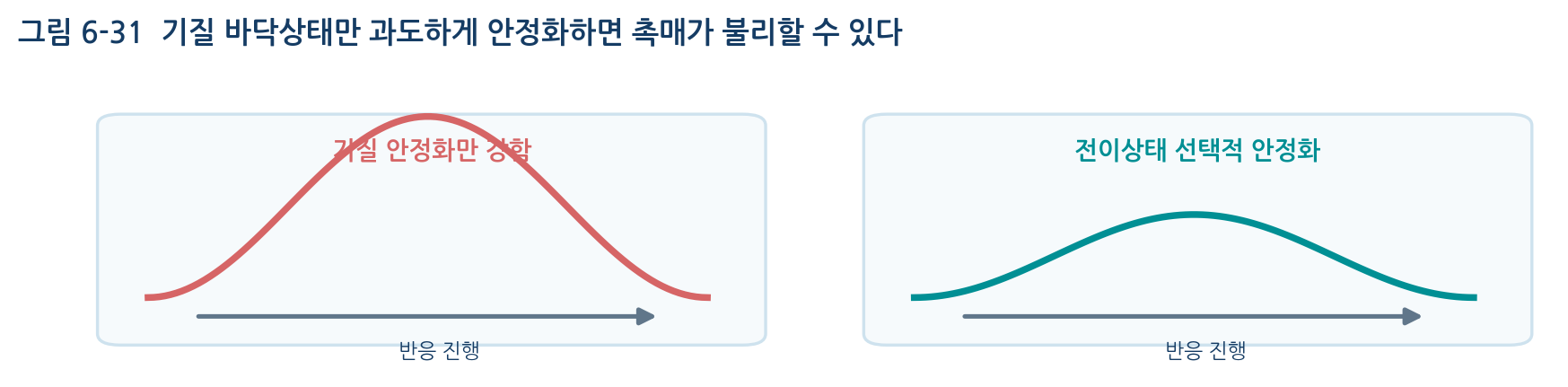
- Over-stabilising the ground-state ES complex can raise the barrier to the transition state
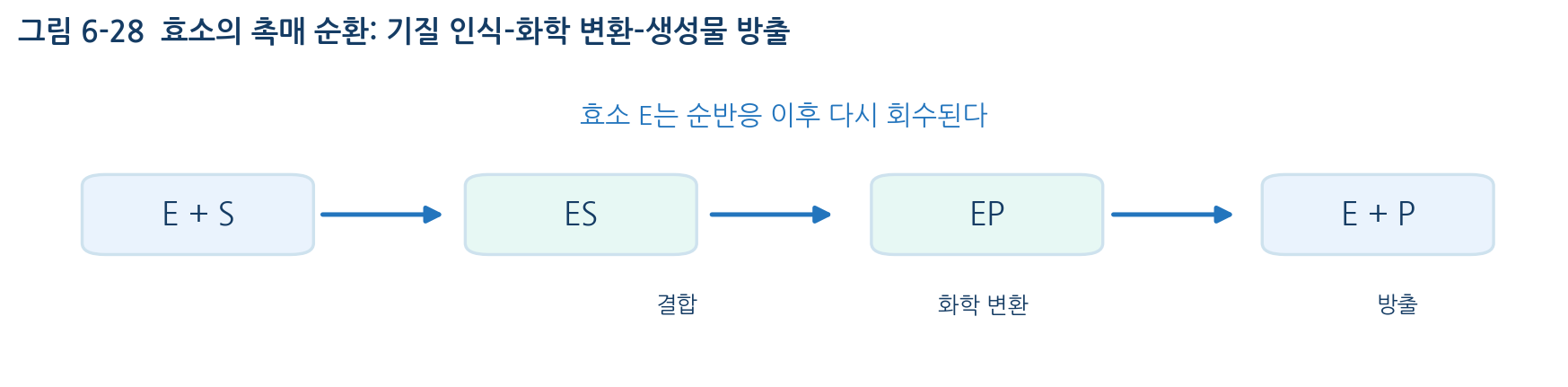
- Efficient catalysis stabilises the transition state preferentially and still releases product
- A transition-state analogue mimics the structure and charge of the transition state, and tight binding makes it a competitive inhibitor
05
Binding energy is used for specificity and catalysis
- Binding free energy includes new interactions, changes in the interactions each partner had with water, and loss of flexibility
- The claim that one new hydrogen bond stabilises by its full energy ignores water replacement and orientation costs
- Binding energy is used three ways: selecting and orienting the correct substrate, stabilising the transition state, and positioning catalytic residues
- Every case must also count the entropy cost and product release
- At 298 K a 1,000-fold acceleration corresponds to ΔΔG-double-dagger = RT ln1000 of about 17.1 kJ/mol if pre-exponential factors match
- Acceleration should not be explained by mechanically summing the energies of a few hydrogen bonds
06
Specific catalytic groups contribute directly
- General acid catalysis donates a proton and general base catalysis accepts one to modulate reactivity
- The histidine imidazole can act as acid or base depending on microenvironment, as can Asp and Glu carboxyls and the Lys amino group
- Covalent catalysis forms a transient bond between enzyme and substrate, with Ser, Cys and Lys as nucleophiles
- Metal ions act as Lewis acids, stabilise charge, orient substrate and water, and form coordination bonds, as Zn2+ does in carbonic anhydrase
- Proximity and orientation bring reacting atoms together and increase productive collisions
- The oxyanion hole and the Asp102-His57-Ser195 triad of serine proteases show several principles combined
- A pH-activity curve alone cannot identify the responsible residue; mutants, structures and isotope effects are needed
References
| Condition | k forward (s-1) | k reverse (s-1) | k forward/k reverse | Equilibrium P fraction |
|---|---|---|---|---|
| No catalyst | 0.020 | 0.005 | 4.0 | 0.800 |
| Simple model with catalyst | 2.00 | 0.500 | 4.0 | 0.800 |
| Contribution | Effect | Limit to check |
|---|---|---|
| Substrate selection | Distinguishes shape, charge and stereochemistry | Strong ground-state binding is not catalysis |
| Reactant orientation | Increases productive collisions | Entropy cost of alignment and fixation |
| Transition-state stabilisation | Contributes to lowering ΔG-double-dagger | Consider the energy budget of the whole path |
| Product release | Allows the cycle to continue | Too-tight product binding slows turnover |