01
Substrate concentration affects the rate
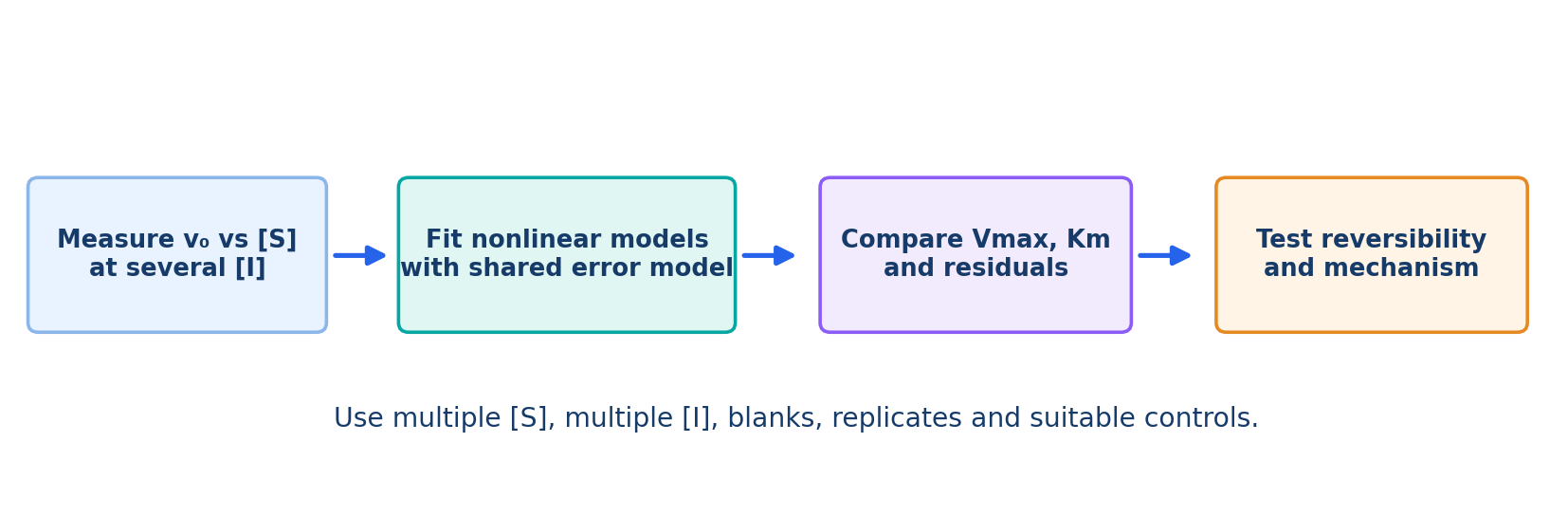
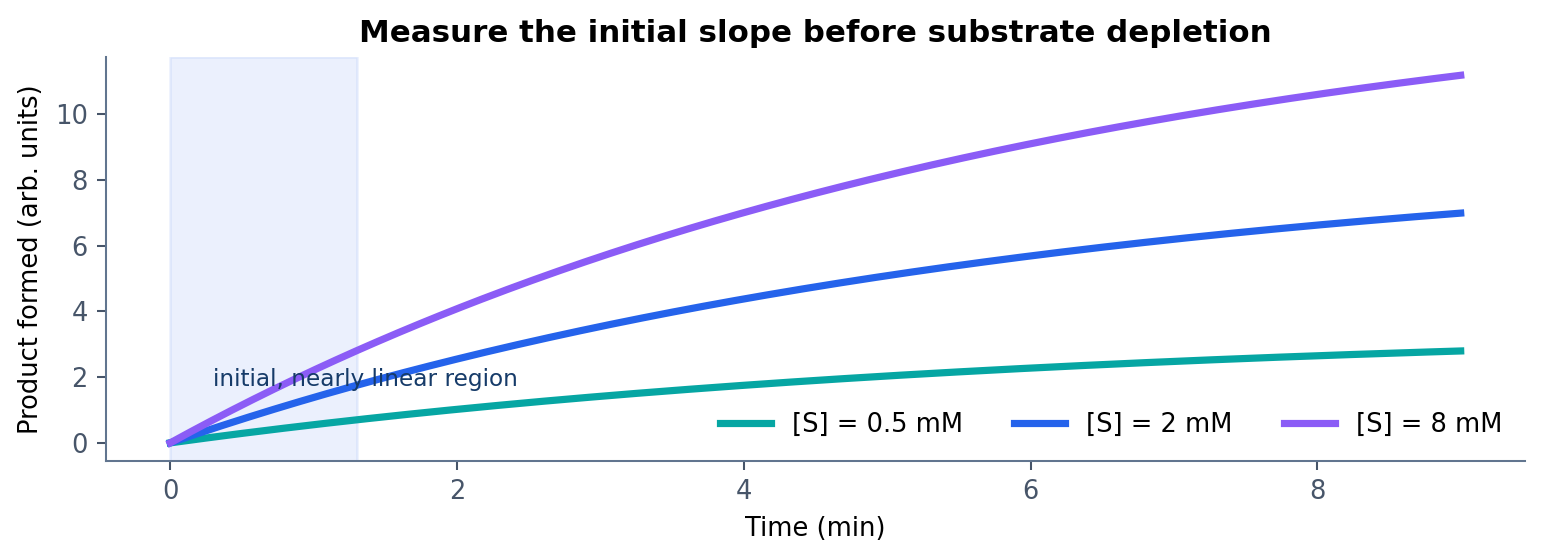
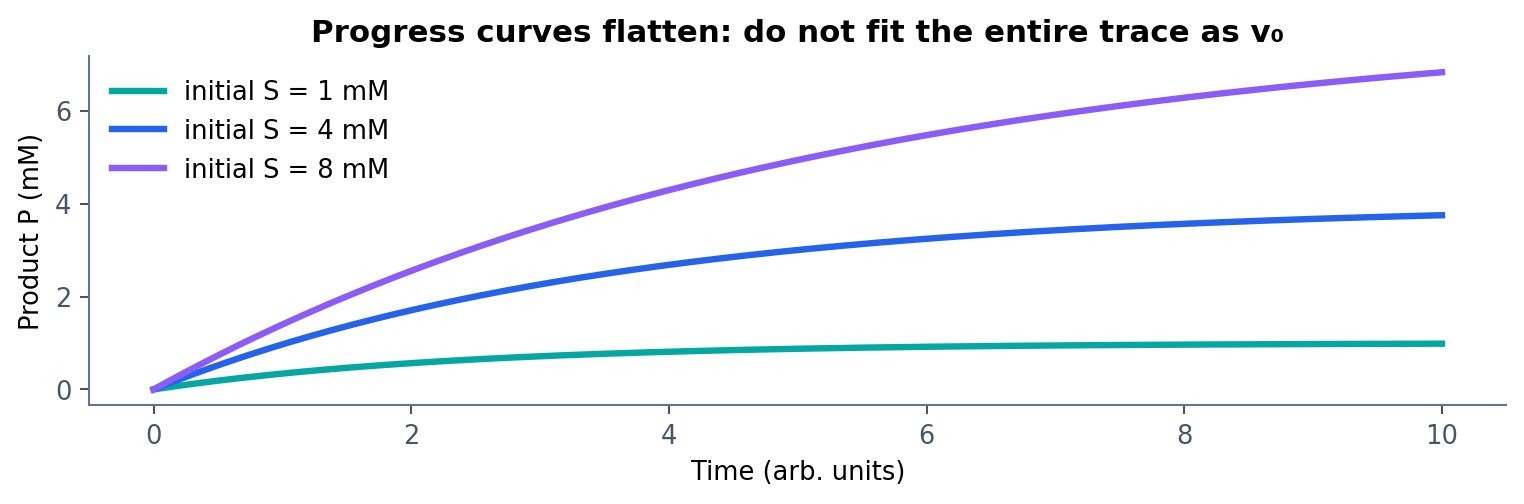
- Initial rate v0 is the product formation rate over the first short interval, when substrate depletion, product inhibition, reverse reaction and inactivation are small
- For a 1:1 reaction S to P, v0 also equals -d[S]/dt
- Measurement conditions hold temperature, pH, ionic strength, enzyme amount, cofactors and time window constant
- Run an enzyme-free blank and replicates, and take the slope of the interval where product increases linearly
- When A = epsilon l c holds, dc/dt = (1/epsilon l)(dA/dt) gives the concentration rate
02
A quantitative relation links substrate concentration and rate
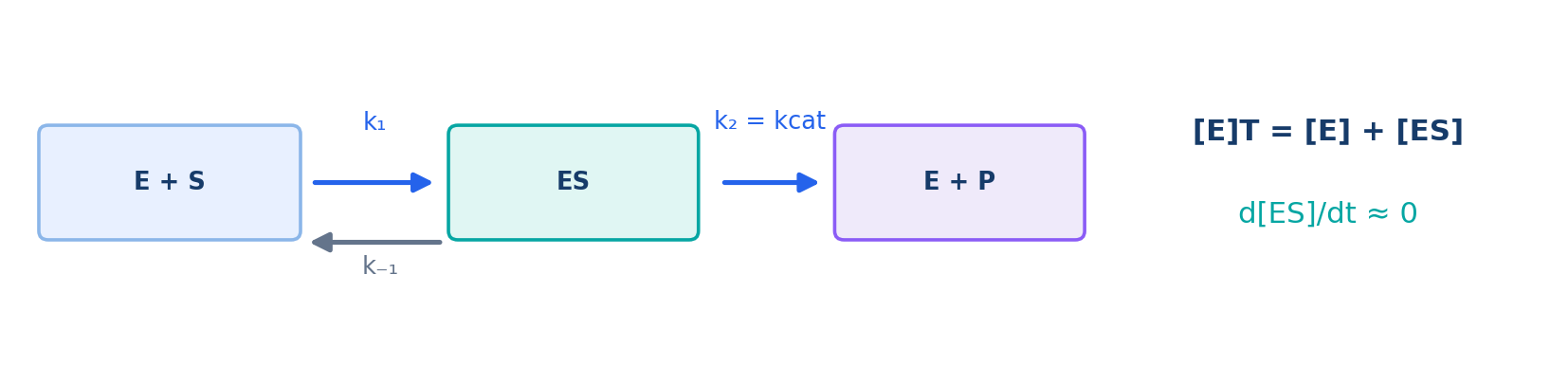
- Minimal mechanism E + S to ES to E + P, with k1 for binding, k-1 for dissociation and k2 for product formation
- Assumptions: negligible reverse reaction, [E]T much less than [S], and quasi-steady state for ES
- d[ES]/dt = k1[E][S] - (k-1 + k2)[ES] is about zero, giving [ES] = [E]T[S]/(Km + [S]) with Km = (k-1 + k2)/k1
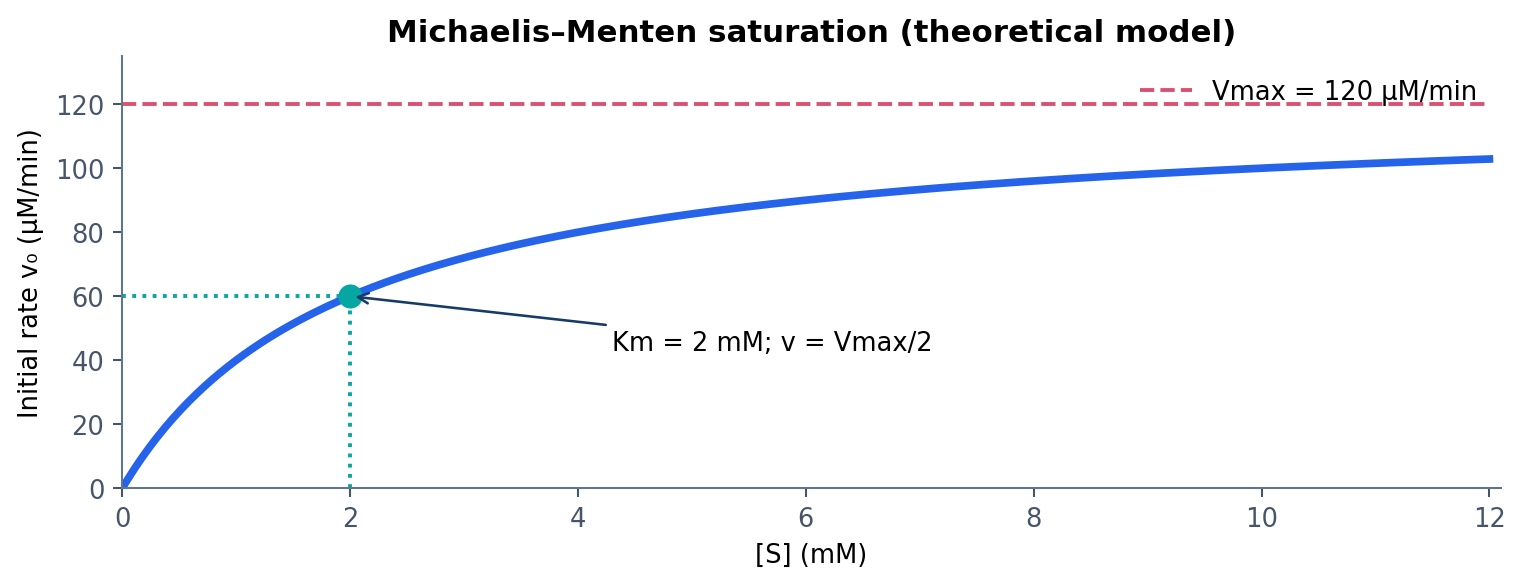
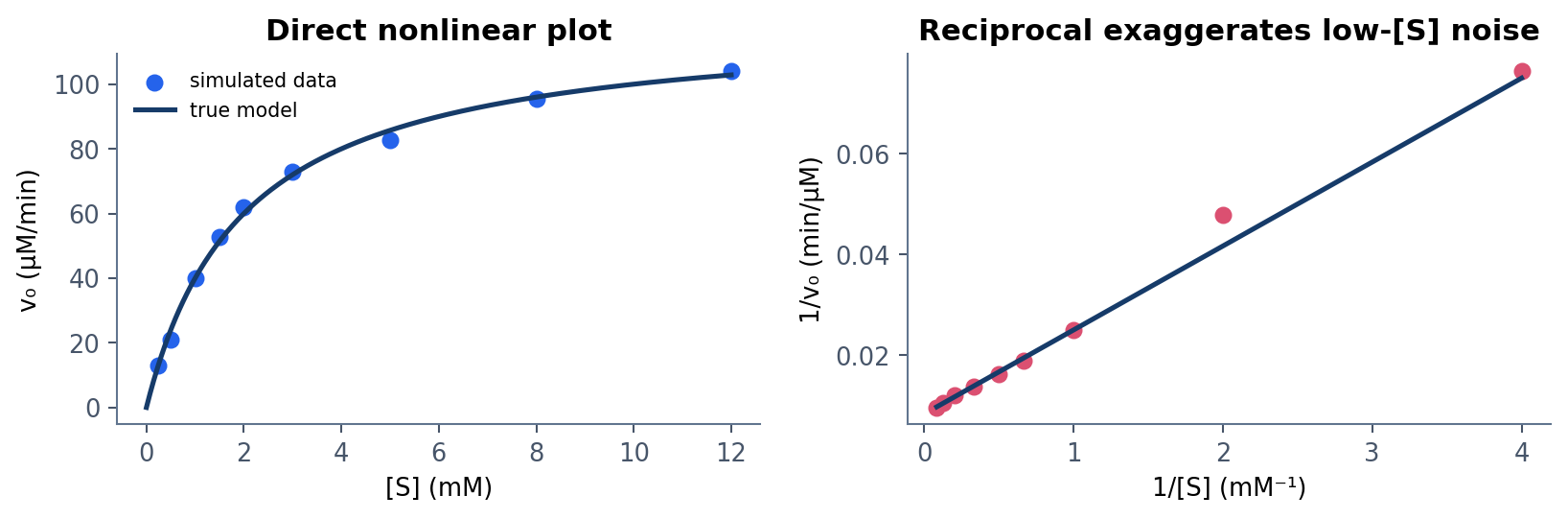
- v0 = Vmax[S]/(Km + [S]) with Vmax = kcat[E]T, and v0 = Vmax/2 when [S] = Km
- Km is generally not the true Kd, and Km approaches Kd only when k2 is much smaller than k-1
03
Kinetic parameters compare enzyme activity
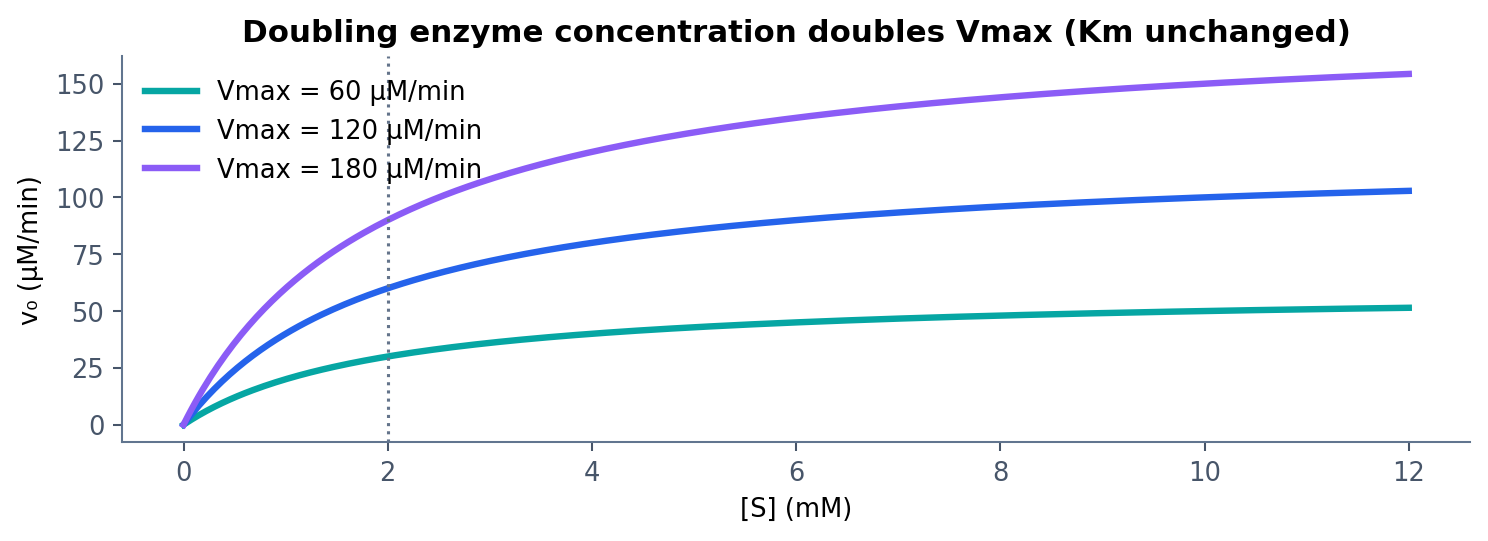
- Vmax depends on enzyme concentration, so activity is normalised as kcat = Vmax/[E]T
- kcat is the turnover per active site per second and kcat/Km the efficiency index at low [S]
- When [S] is much less than Km, v0 approximates (kcat/Km)[E]T[S], a second-order form
- Comparing purified enzymes requires active-site concentration, degree of inactivation, temperature, pH and cofactors
- Comparing kcat between enzymes is only meaningful when substrate, conditions and rate-limiting step are comparable
04
[Separate note 6-1] Double-reciprocal transformation
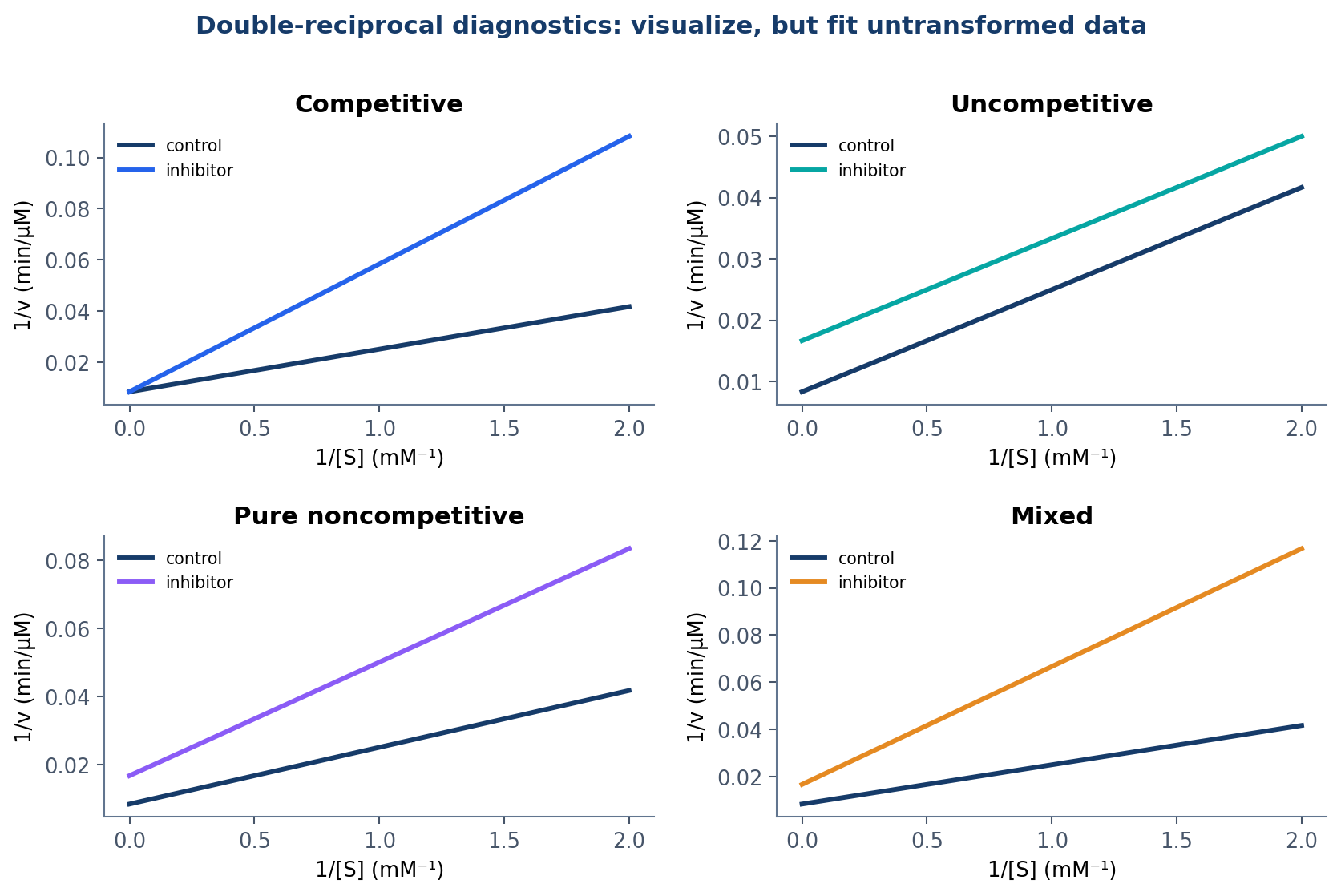
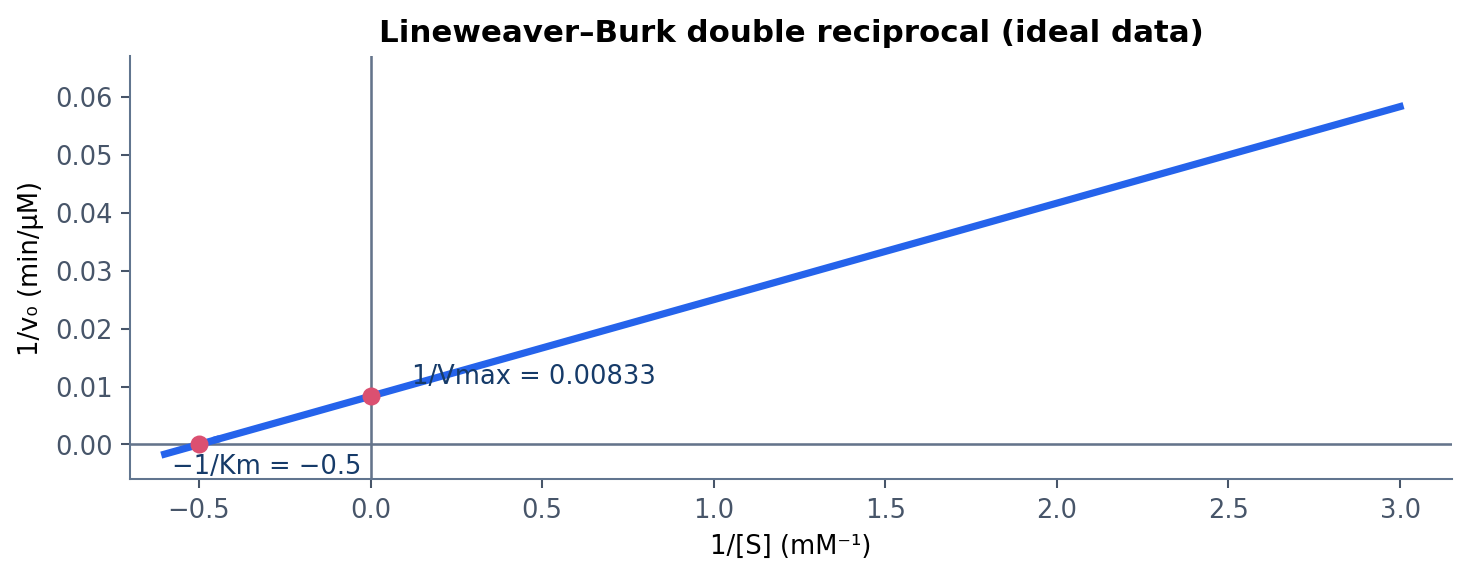
- 1/v0 = (Km/Vmax)(1/[S]) + 1/Vmax, with slope Km/Vmax, y intercept 1/Vmax and x intercept -1/Km
- The Lineweaver-Burk plot is useful for visualising theoretical differences between inhibition types
- Its weakness is that small rate errors at low [S] are amplified by the reciprocal transformation
- Modern practice fits the original [S] and v0 data by non-linear regression and checks weighting, residuals and uncertainty
05
Most enzyme reactions involve two or more substrates
- Phosphate transfer by transferases and electron transfer by oxidoreductases both involve two substrates
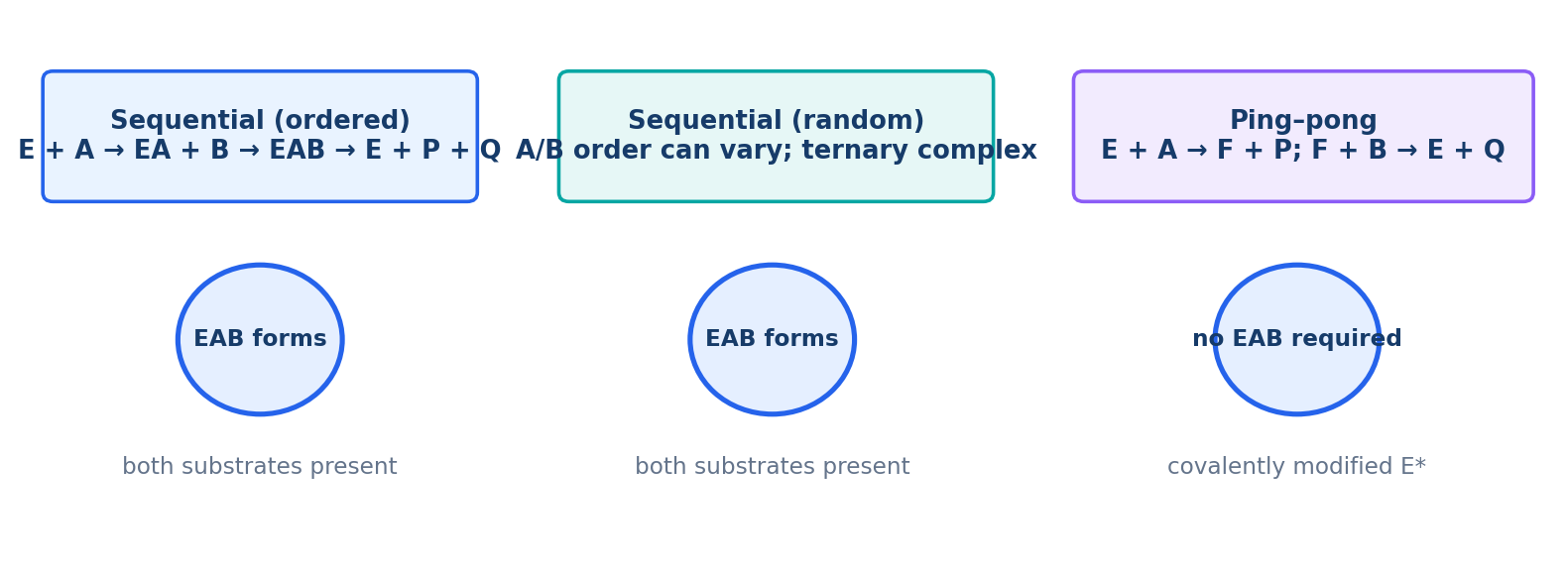
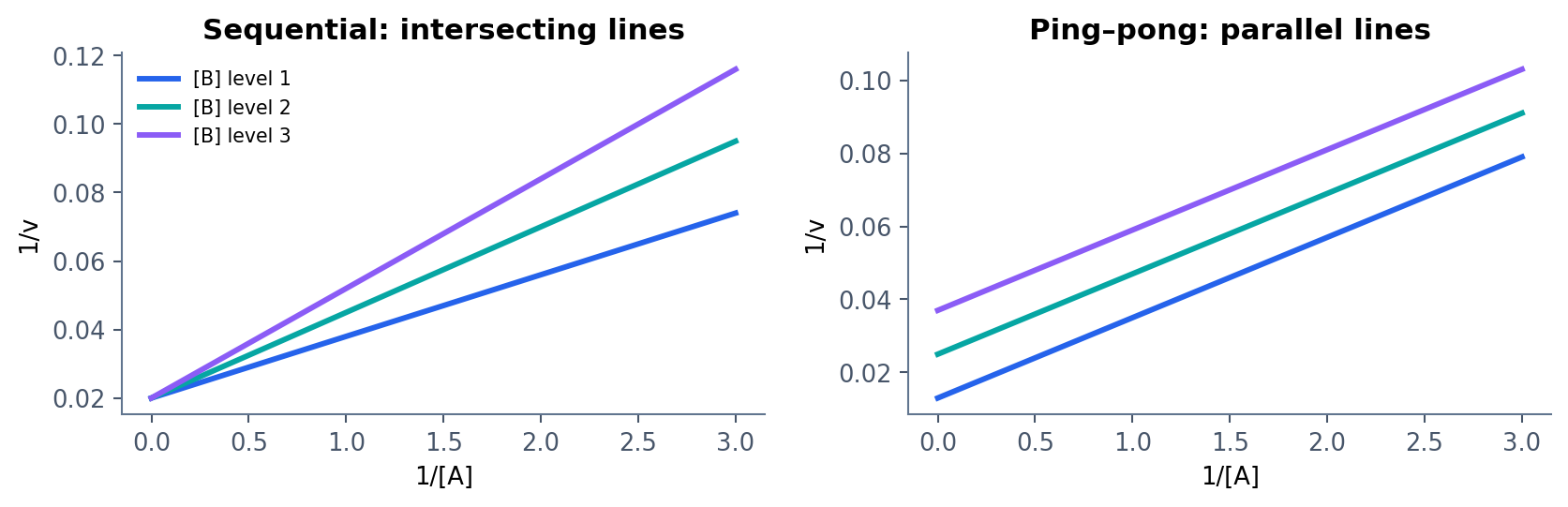
- A sequential mechanism forms a ternary EAB complex, either ordered with a fixed binding order or random
- In a ping-pong mechanism the first product leaves, the enzyme persists as a modified form F, and the second substrate restores E
- The simple ping-pong model does not require a ternary complex
06
Enzyme activity depends on pH
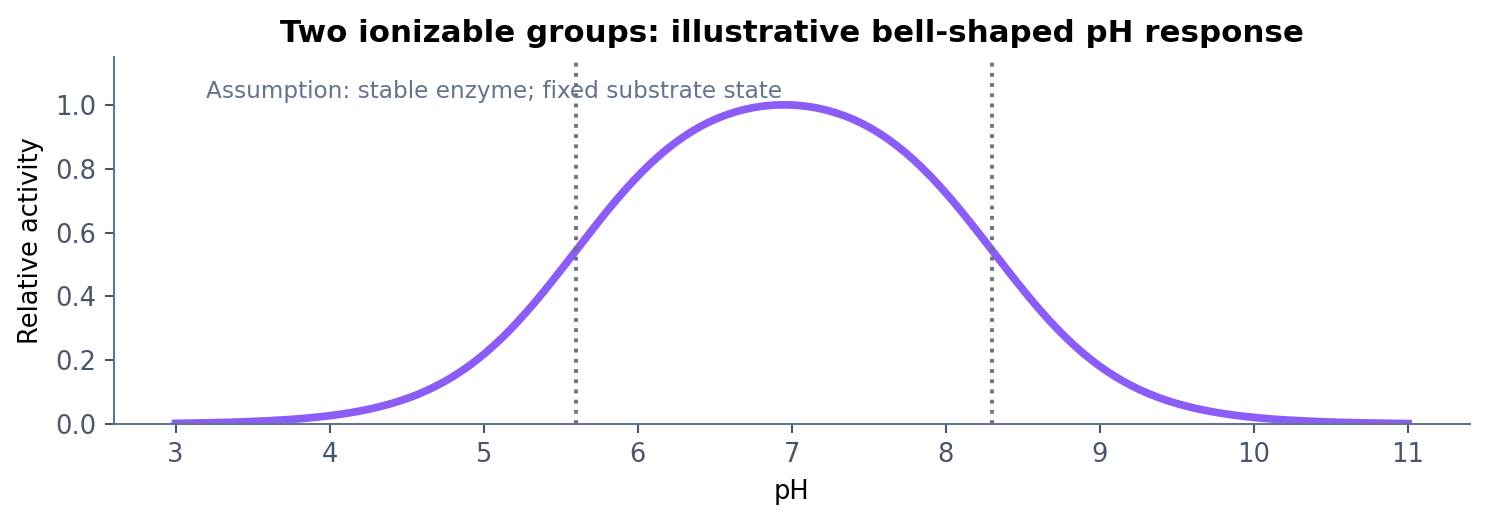
- Protonation of active-site acid and base groups, substrate ionisation and structural stability all create pH dependence
- Bell-shaped activity-pH curves are common but not universal
- The optimum pH can shift with measurement conditions and substrate
- Equal total substrate at each pH can still mean different reactive ionised fractions, so buffer, ionic strength and pre-treatment must be controlled
07
Pre-steady-state kinetics gives evidence on individual steps
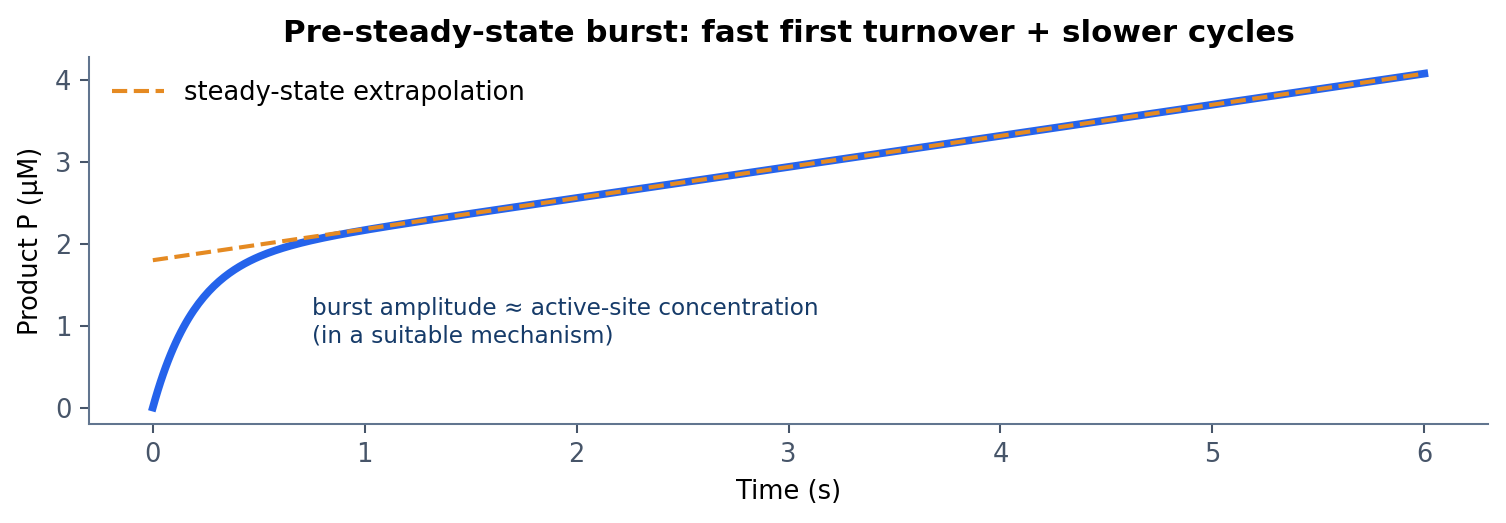
- Pre-steady state is the fast phase right after mixing, before ES reaches quasi-steady state
- Stopped-flow and rapid-quench methods reach timescales inaccessible to manual sampling
- A burst is a fast initial product phase followed by a slower linear phase
- The burst suggests a fast first step and a slower later step such as product release, but reading its amplitude as active-site concentration requires a verified pathway
08
Enzymes are inhibited reversibly or irreversibly
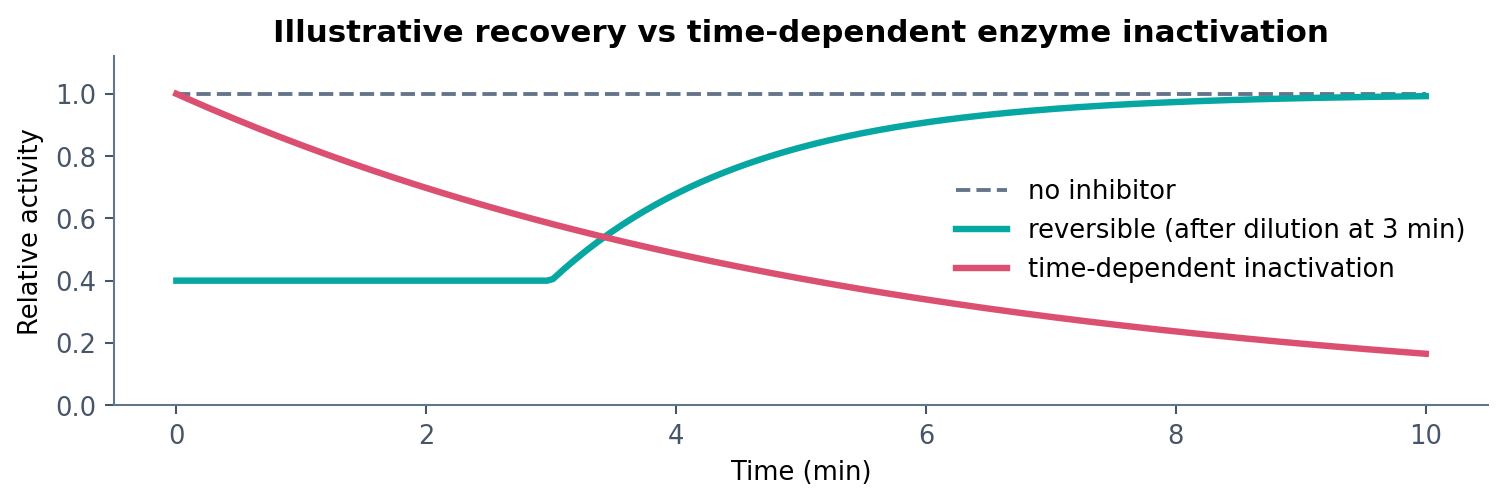
- Reversible inhibitors act through non-covalent binding and activity can recover when the inhibitor is removed
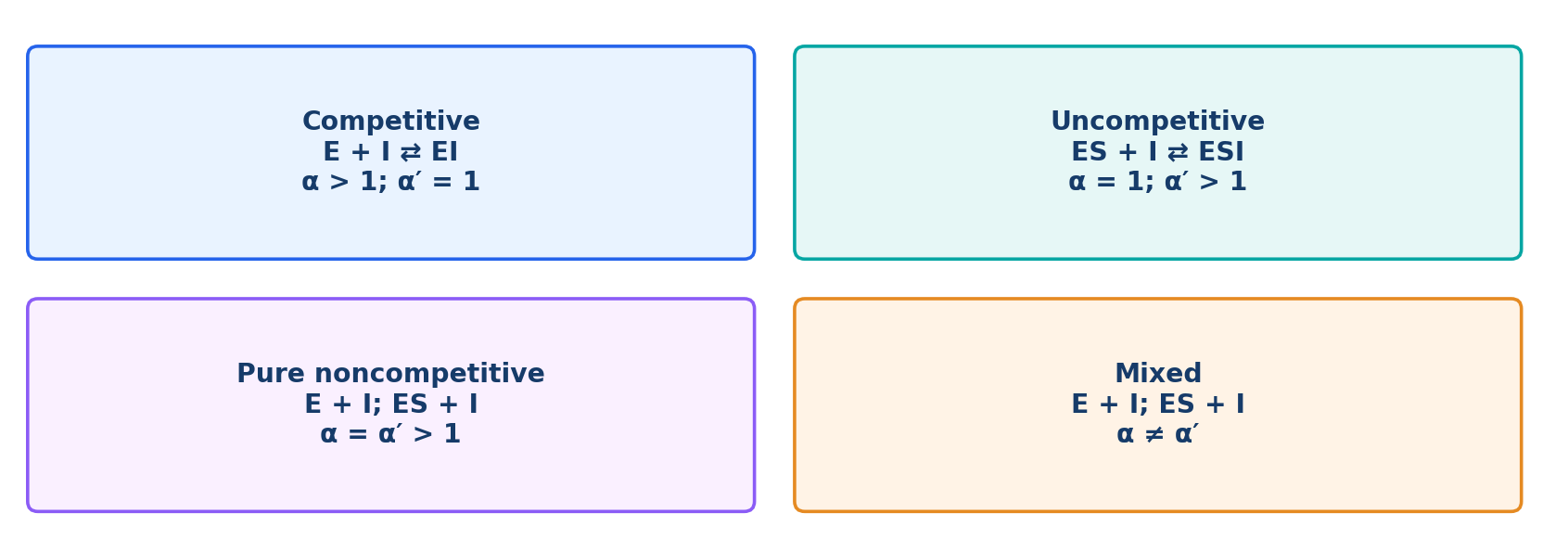
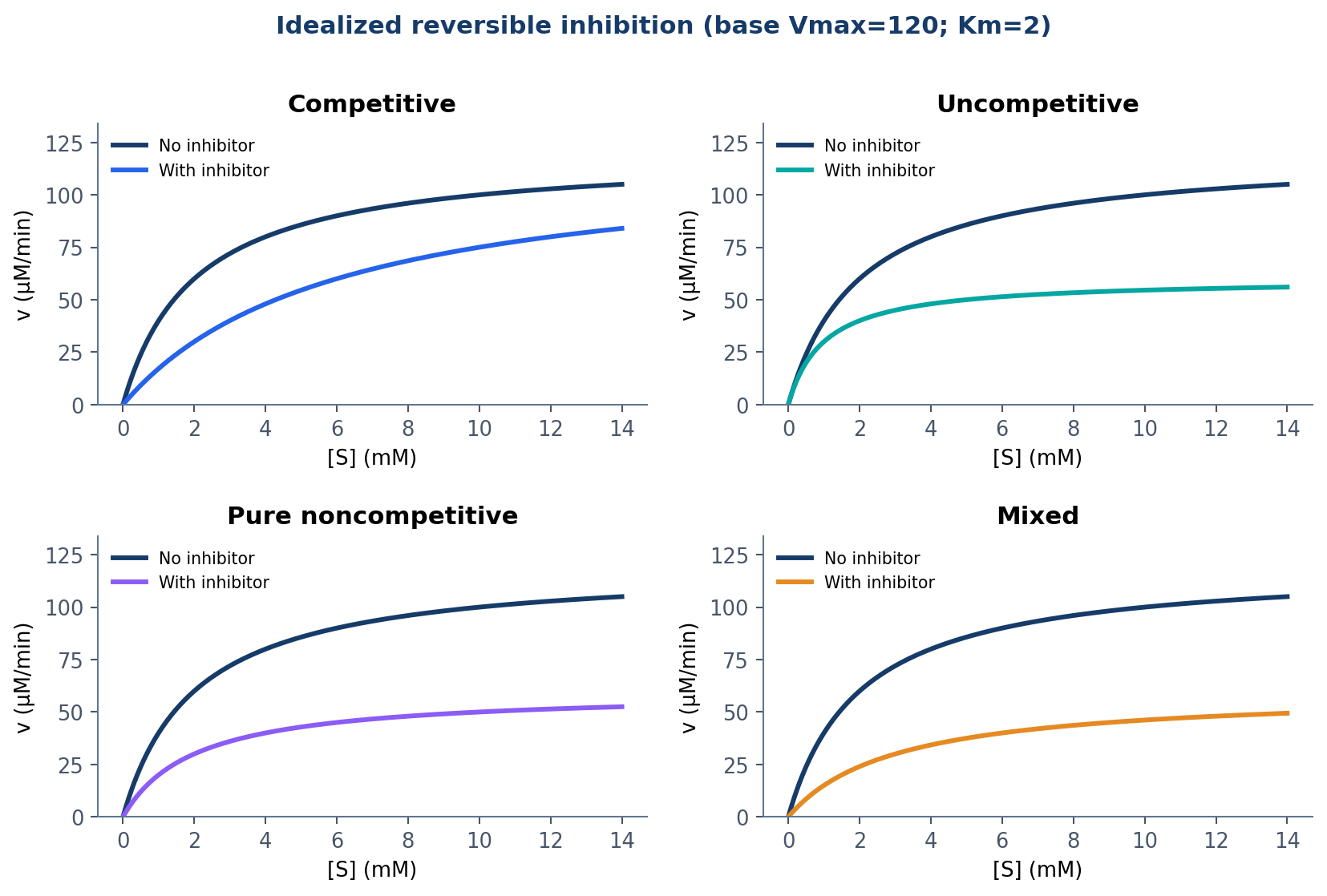
- v0 = Vmax[S]/(αKm + α′[S]) with α = 1 + [I]/Ki and α′ = 1 + [I]/Ki′, so Vmax,app = Vmax/α′ and Km,app = αKm/α′
- Competitive raises apparent Km with unchanged Vmax, uncompetitive lowers both, pure non-competitive lowers Vmax with unchanged Km, and mixed lowers Vmax with variable Km
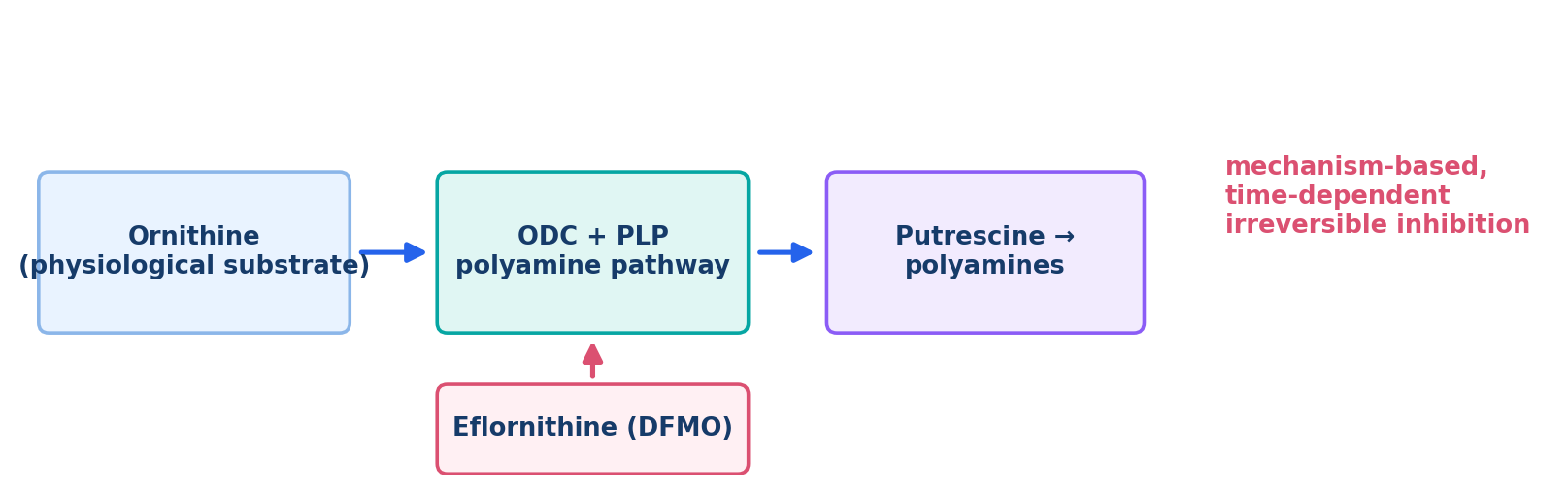
- Irreversible or time-dependent inhibition reduces the amount of active enzyme, often through covalent modification
- Deepening inhibition over time alone does not prove irreversibility, so recovery after dilution or dialysis and mass data are needed
References
| Parameter | Meaning | Unit | Caution |
|---|---|---|---|
| Vmax | Limiting initial rate approached at saturating substrate | concentration/time | Depends on enzyme concentration. |
| Km | Substrate concentration giving v0 = Vmax/2 | M or mM | Not always equal to the binding affinity. |
| kcat | Turnover number per active site at saturation | s-1 | Requires the active-site concentration. |
| kcat/Km | Index of catalytic efficiency at low [S] | M-1 s-1 | Record reaction conditions and substrate. |
| Model | α, α′ | Apparent Km | Apparent Vmax |
|---|---|---|---|
| Competitive | α > 1, α′ = 1 | Increases | Unchanged |
| Uncompetitive | α = 1, α′ > 1 | Decreases | Decreases |
| Pure non-competitive | α = α′ > 1 | Unchanged | Decreases |
| Mixed | α not equal to α′, both > 1 | May increase or decrease | Decreases |