01
The characteristic bases and pentoses
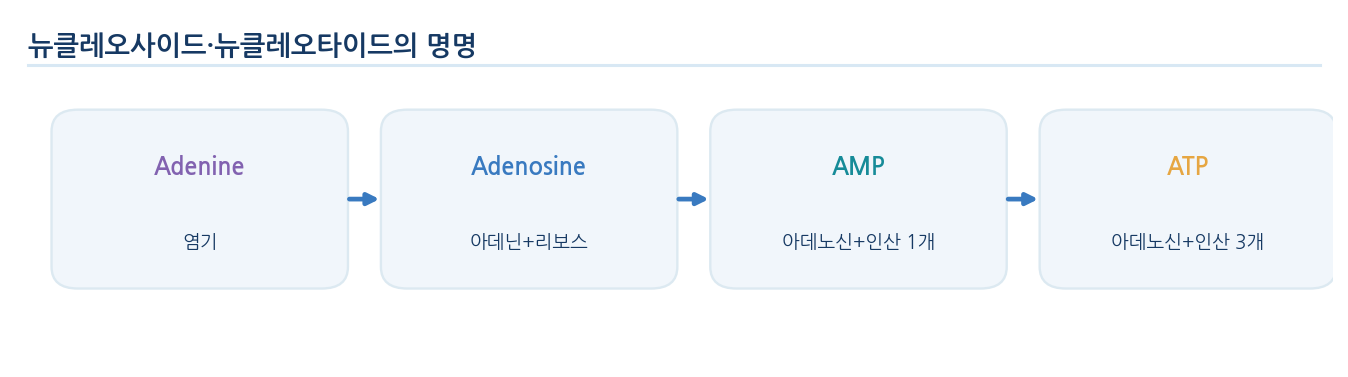
- A nucleotide is a base plus a pentose plus one or more phosphates, while base and sugar alone give a nucleoside
- Phosphorylating a nucleoside gives a nucleotide, so ATP with three phosphates is still a nucleotide
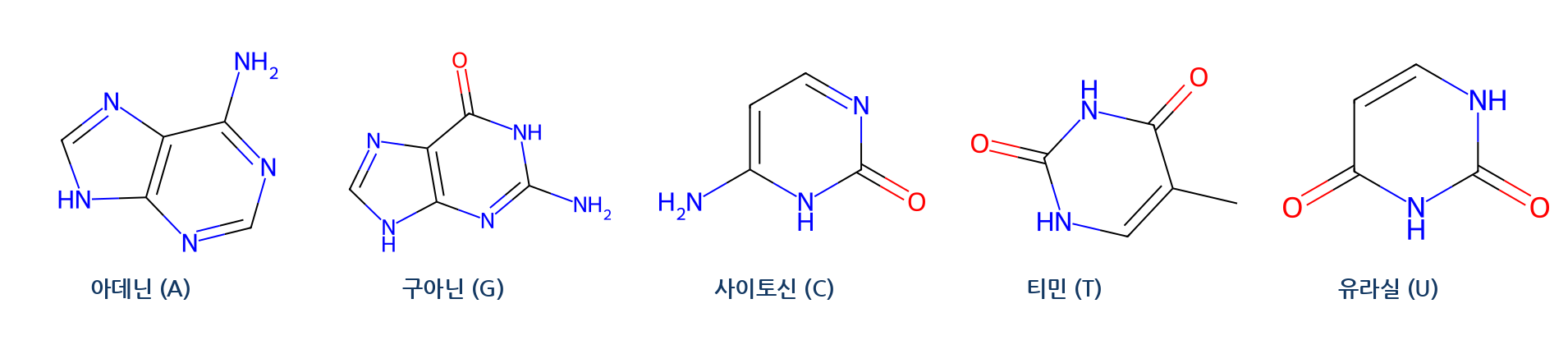
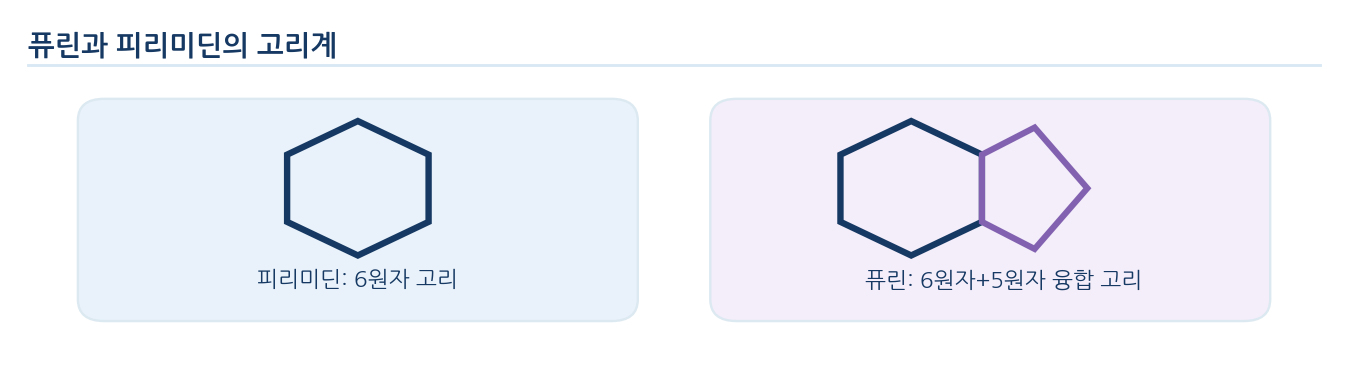
- Purines are adenine and guanine with fused two-ring structures
- Pyrimidines are cytosine, thymine and uracil with a single six-membered ring
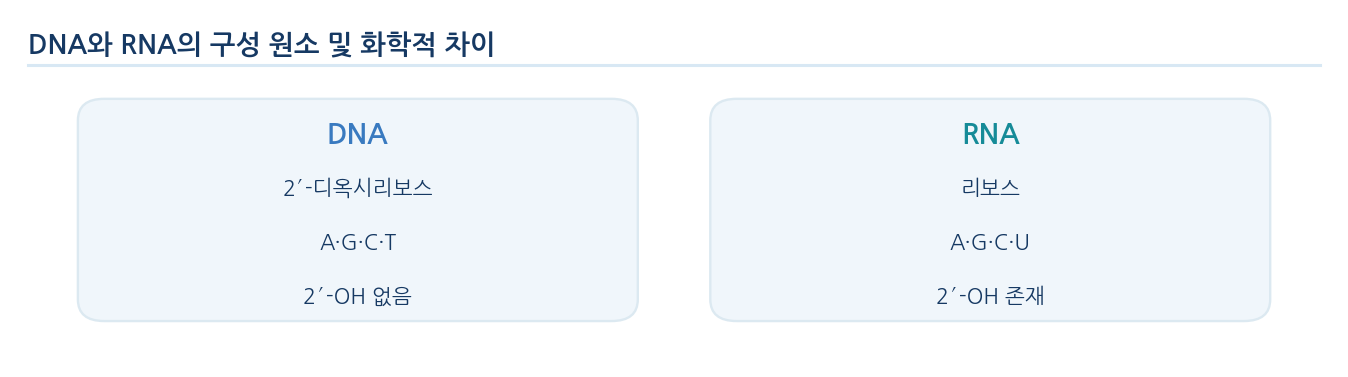
- DNA and RNA share A, G and C, with T standard in DNA and U in RNA, though modified bases prevent absolute generalisation
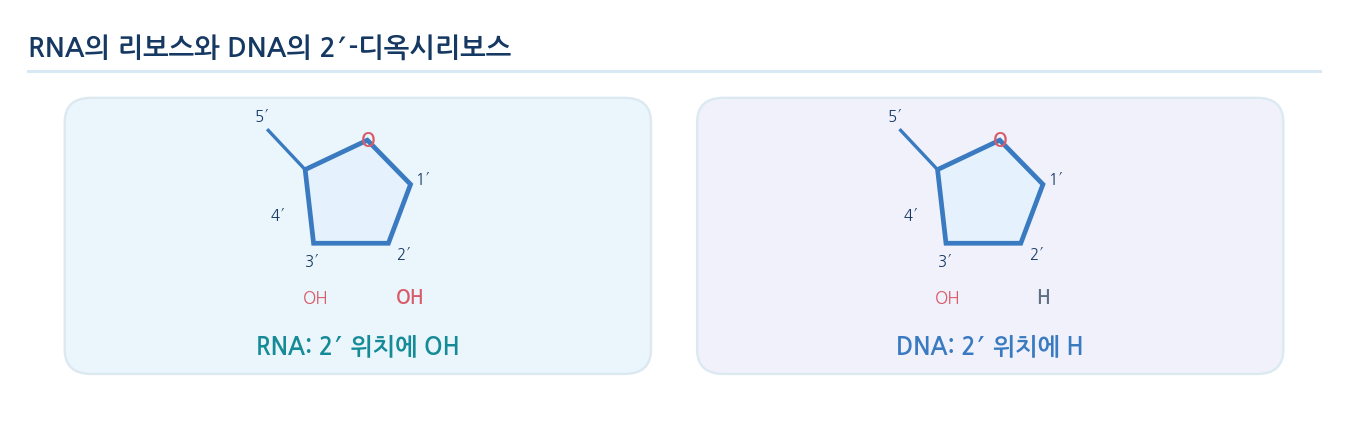
- The RNA sugar is ribose with a 2-prime OH, and the DNA sugar is 2-prime deoxyribose with H at that position
- Sugar carbons are numbered 1-prime to 5-prime, with 1-prime for base attachment, 3-prime OH for chain extension and 5-prime for phosphate linkage
- The 2-prime OH aids folding but can act as a nucleophile on the adjacent phosphate, which makes RNA alkali-labile
- Adenine with ribose gives adenosine, adding one phosphate at 5-prime gives AMP, and the DNA notation is dAMP
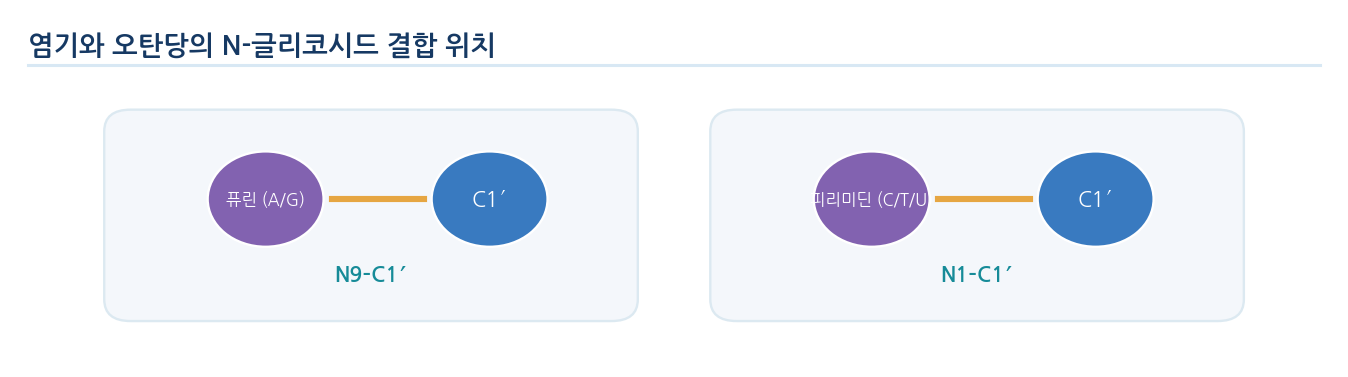
- Purine N9 and pyrimidine N1 form the beta-N-glycosidic bond with sugar C1-prime
02
Nucleotides are joined by phosphodiester bonds
- A phosphodiester bond is one phosphate esterified to oxygen atoms from the hydroxyls of two different sugars
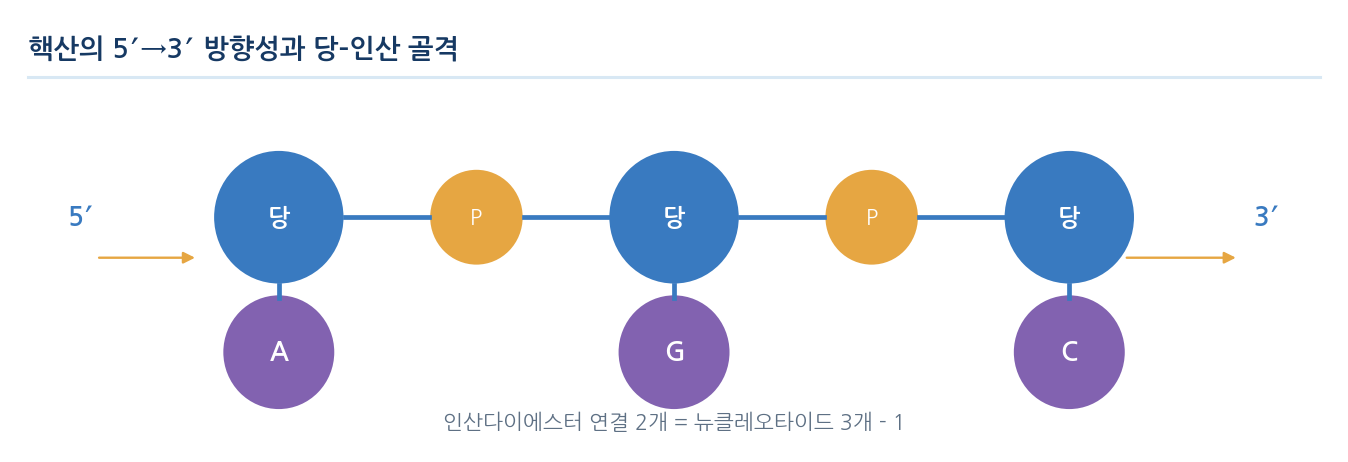
- Most links join the 3-prime position of one residue to the 5-prime of the next, giving a 3-prime to 5-prime phosphodiester bond
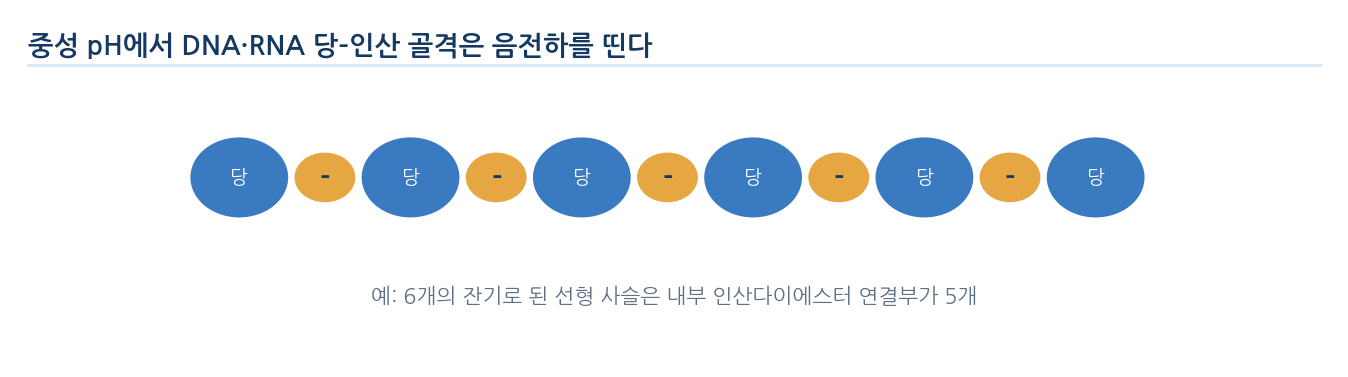
- The sugar-phosphate backbone is hydrophilic and carries negative charge near neutral pH
- Sequences are written 5-prime to 3-prime, with a 5-prime phosphate or 5-prime OH at one end and usually a 3-prime OH at the other
- The claim that every 5-prime end must carry a phosphate is false
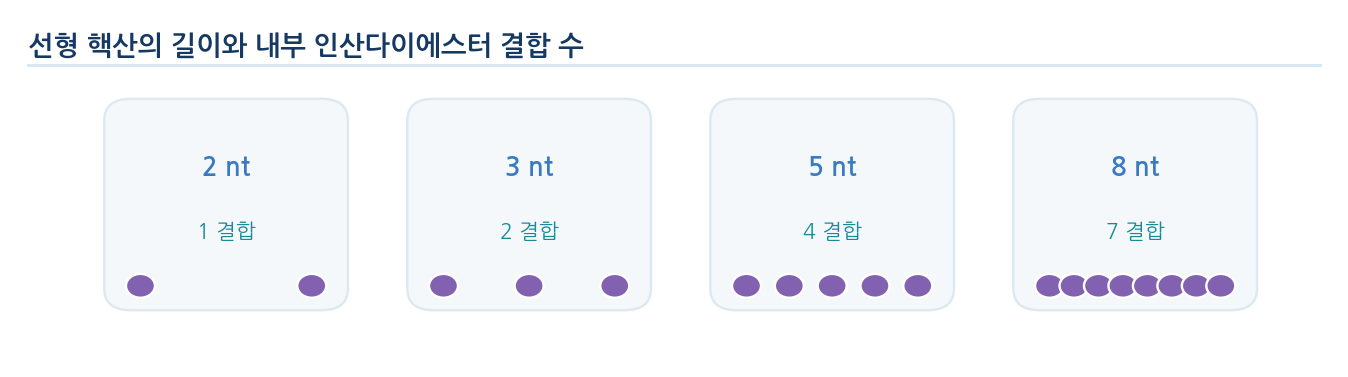
- A linear strand of n residues has n minus 1 phosphodiester bonds, so ten residues give nine
- A 10 bp linear duplex has 2(10 minus 1) = 18 internal links
- Cellular synthesis uses dNTPs or NTPs, and the 3-prime OH of the growing chain attacks the alpha phosphate to form the new bond and release pyrophosphate
- The reaction needs enzyme and metal ions, so the idea that two free nucleotides simply lose one water is inaccurate
- Internal phosphate linkages carry roughly a single negative charge, making long nucleic acids polyanions
- Charge depends on pH, terminal phosphorylation and chemical modification
- In alkali the RNA 2-prime OH can attack the adjacent phosphate to give cleavage and a 2-prime,3-prime cyclic phosphate, and though DNA cannot follow this path easily it is not absolutely stable under all conditions
03
Base properties shape the three-dimensional structure
- Purines and pyrimidines have nearly planar rings with conjugated electron systems
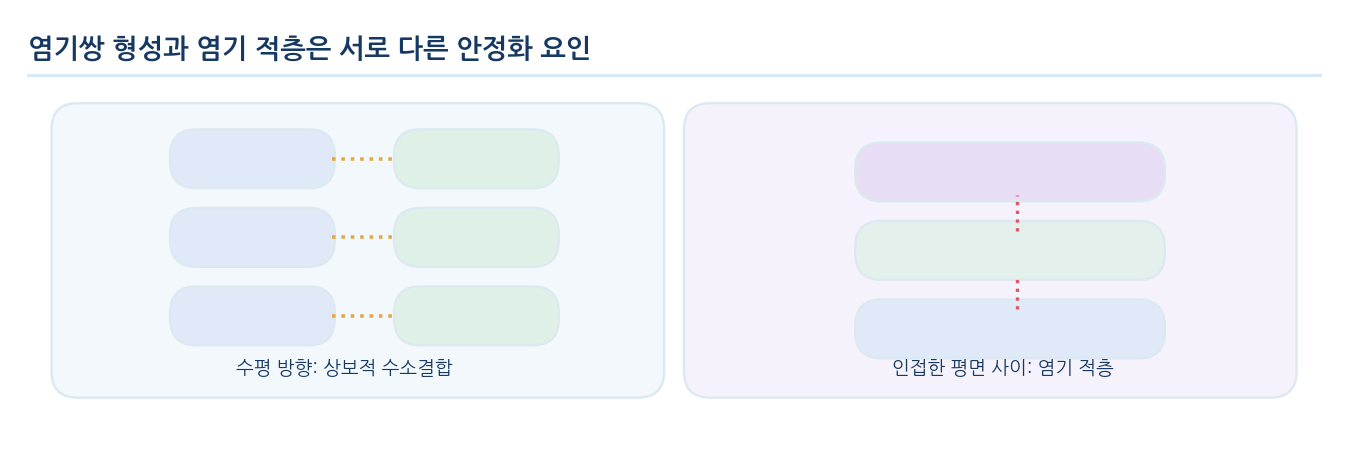
- Stacking of adjacent bases combines dispersion forces, the hydrophobic effect and electrostatic interactions
- Stability depends on sequence, neighbouring pairs, ions and water rather than hydrogen bond count alone
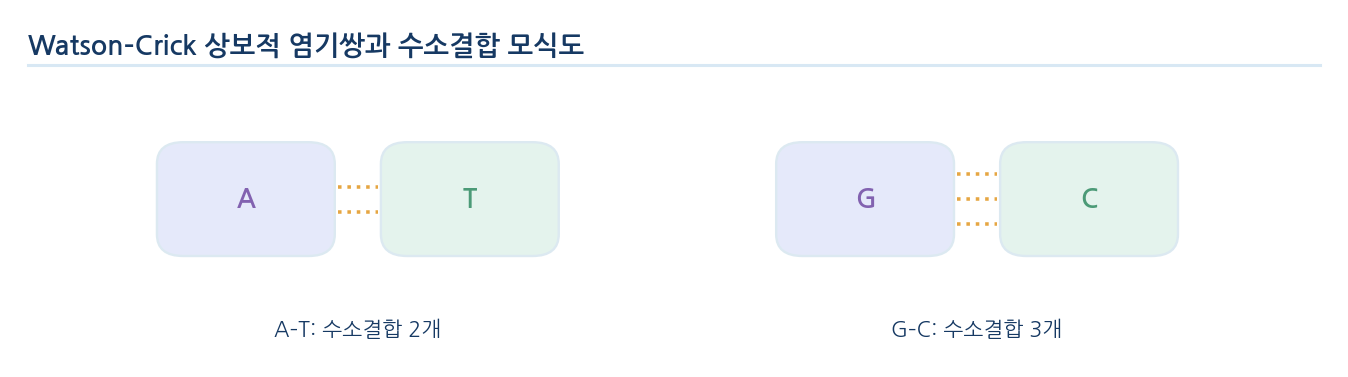
- Canonical pairs have two hydrogen bonds for A-T and three for G-C, with A-U in RNA
- One purine with one pyrimidine keeps the duplex width relatively constant
- Bond count alone cannot fix the melting temperature of a whole DNA molecule
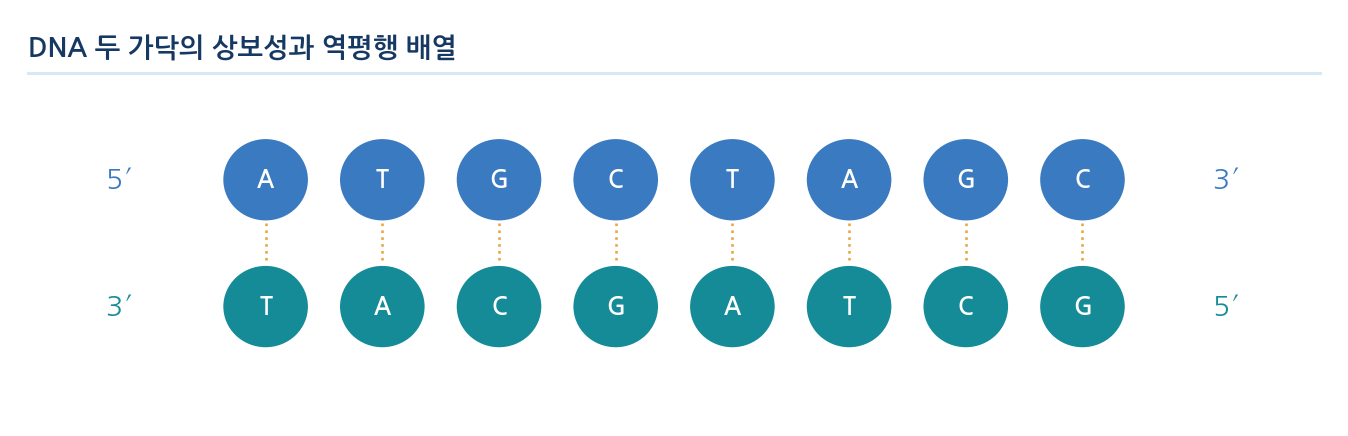
- The strands are antiparallel, so 5-prime ATGCTAGC 3-prime pairs with 3-prime TACGATCG 5-prime, written 5-prime GCTAGCAT 3-prime
- In a duplex the counts of A and T are equal, as are those of G and C
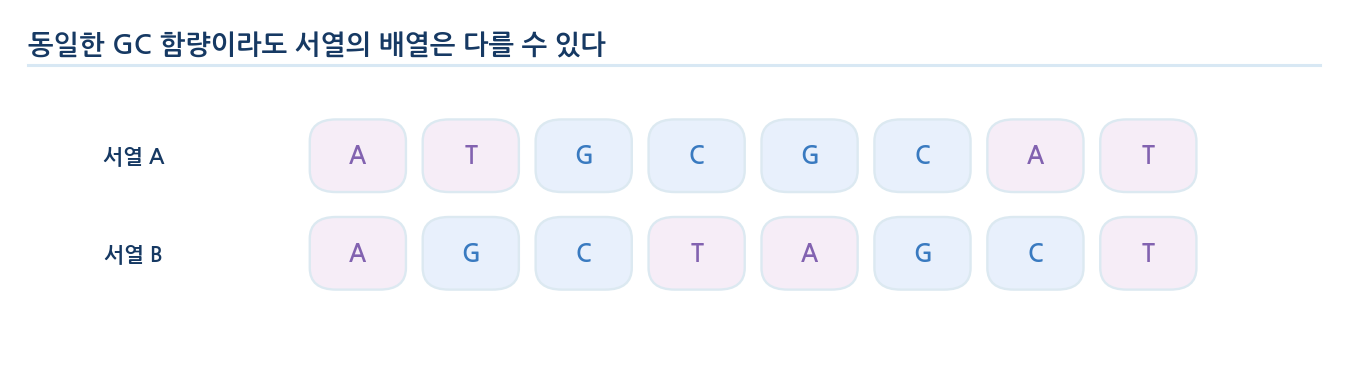
- Higher GC content tends to raise stability, though base order and solution conditions matter too
- Single-stranded RNA can still form stem-loops and hairpins through complementary segments
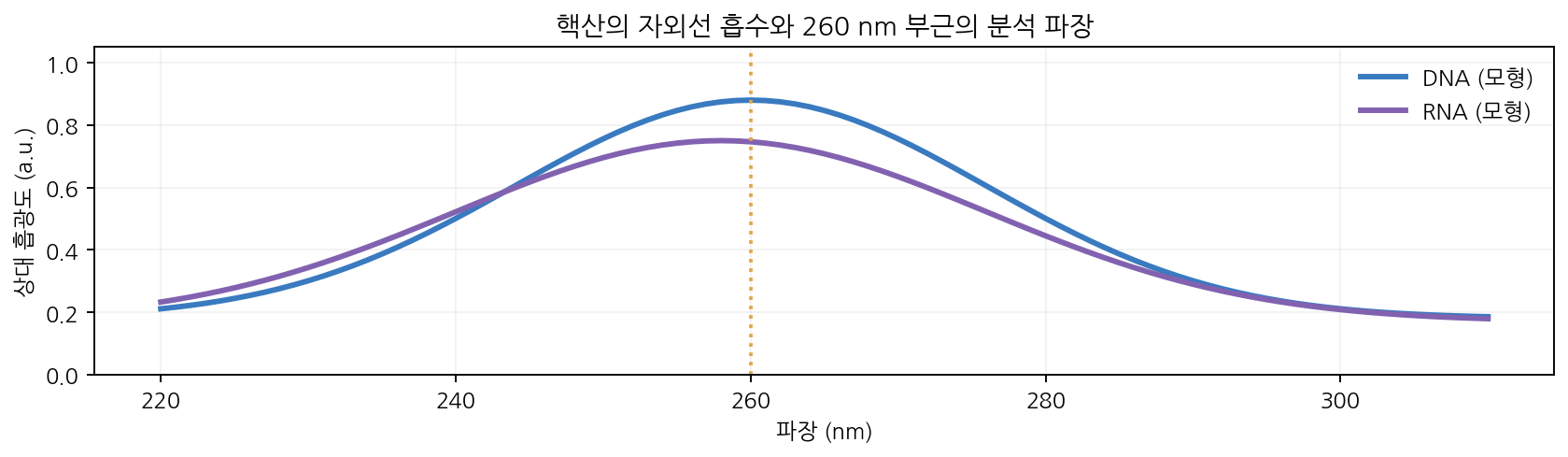
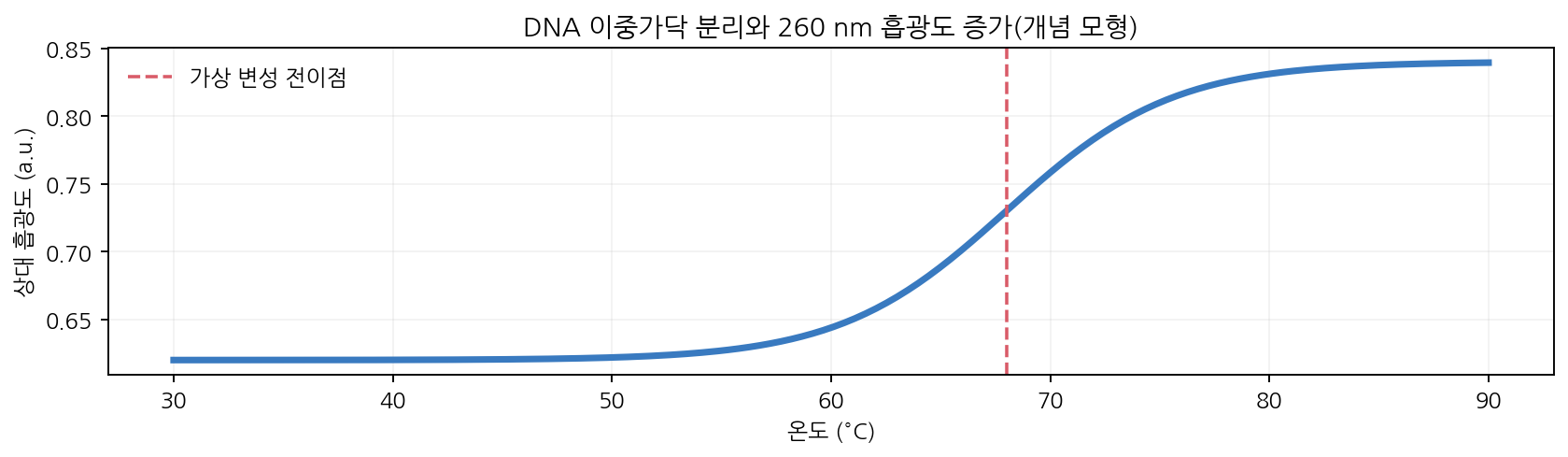
- Absorbance at 260 nm is used for quantitation, and loss of stacking on denaturation gives a hyperchromic effect
- High absorbance does not guarantee a pure sample
04
Quantitative calculations and applications
- A 25-residue linear strand has 24 internal links, and a 25 bp linear duplex has 48
- Terminal phosphorylation and the number of internal links are separate questions
- The complement of 5-prime AGTCCA 3-prime is 3-prime TCAGGT 5-prime, written 5-prime TGGACT 3-prime
- A simple complement must be distinguished from a reverse complement
- The canonical hydrogen bond total is 3 per GC pair plus 2 per AT pair, so 1,000 bp at 40 percent GC gives 400 x 3 plus 600 x 2, that is 2,400
- That number is not a thermodynamic measure of whole-molecule stability
- With epsilon 1.50e4 L per mol per cm, path length 1.00 cm and A 0.300, the concentration is 2.00e-5 M, that is 20.0 micromolar
- The coefficient is a practice assumption, not a universal conversion for real samples
05
Student investigations
- Identify molecules from the base, pentose and phosphate count on cards
- Check directionality and bond count geometrically with a linear duplex model
- Estimate concentration from a given molar extinction coefficient using A = epsilon l c
- Argue how structural differences between DNA and RNA lead to different chemical behaviour
References
| Class | Base | Standard base in DNA | Standard base in RNA |
|---|---|---|---|
| Purine | Adenine and guanine | A, G | A, G |
| Pyrimidine | Cytosine | C | C |
| Pyrimidine | Thymine | T | Replaced in principle by U |
| Pyrimidine | Uracil | Replaced in principle by T | U |
| Base | Ribonucleoside | Typical 5-prime monophosphate | DNA notation |
|---|---|---|---|
| Adenine | Adenosine | AMP | dAMP |
| Guanine | Guanosine | GMP | dGMP |
| Cytosine | Cytidine | CMP | dCMP |
| Uracil | Uridine | UMP | none |
| Thymine | Ribothymidine, rare | none | dTMP |
| Item | Relation | Condition to check |
|---|---|---|
| Links in one linear strand | n minus 1 | Check terminal modification and circularity separately |
| Links in a linear duplex | 2(n minus 1) for n bp | n residues per strand with no nicks |
| GC content | GC bp divided by total bp times 100 | Applies to a fully complementary duplex |
| Model absorbance | A = epsilon l c | State epsilon, path length and wavelength |